Here’s the thing about summer drinks: they disappear fast. You mix up a pitcher of something fruity, and it’s gone before the ice even melts. That’s exactly why I started making this plumlemonadeconcentrate. I got tired of staring at a bowl of plums and apricots that were about to turn, and I couldn’t handle one more jar of plum jam. So I made lemonade concentrate instead. Now I have a shelf of mason jars ready to go, and honestly, it’s the smartest thing I’ve done all season.
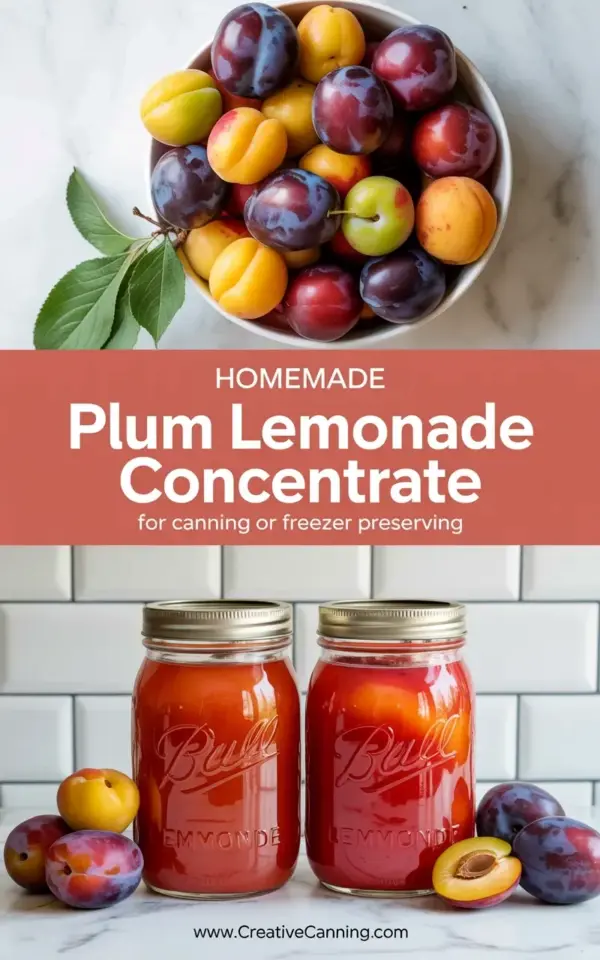
I’m standing at my counter right now, looking at a white ceramic bowl packed with dark purple plums and those golden-yellow apricots. There’s a single green leaf from the plum tree still attached to one of the fruit. It’s a pretty scene, but it’s also a practical one. These two fruits together make a lemonade that’s way better than anything you’ll buy in a store. The plums give it that deep, almost wine-like color, and the apricots add a soft, floral sweetness. It’s a match made in canning pot heaven.
Why Canning or Freezing Plum Lemonade Concentrate Works
You might wonder why you’d bother making concentrate instead of just juice. Well, the answer is space and versatility. A shelf of concentrate takes up less room than a freezer full of juice jugs. When you make it as a concentrate, you control the sweetness at the end. Some days you want a tart, sharp lemonade that makes your cheeks pucker. Other days you want something sweeter for the kids. The concentrate lets you have it both ways.
The color is the real selling point here. Look, I’ve made strawberry lemonade that turns brown after a day. This stuff stays a gorgeous, deep coral-pink. The natural pigments in the plums hold up surprisingly well to heat and freezing. You pour it over ice, add a splash of water, and it looks like something from a fancy cocktail bar. Even the label on my jar says “coral” and honestly, that’s the perfect name for this shade.
How to Pick the Best Plums and Apricots for Homemade Lemonade
You don’t need perfect, picture-perfect fruit for this recipe. In fact, the uglier the better. I use plums that are super ripe, the kind that are almost too soft to eat out of hand. That softness means they’re packed with sugar and flavor. The same goes for the apricots. Look for ones that give slightly when you press them. If they’re rock hard, they’re not ready. If they’re bruised, that’s fine, just cut the bad spots off.
Here’s what I look for at the market or in my own backyard:
– Plums that are deeply colored and heavy for their size.
– Apricots that smell sweet at the stem end.
– Fruit that’s slightly wrinkled, that’s a sign of concentrated sweetness.
– A mix of varieties if you have them, it makes the flavor more interesting.
I will say this though: taste one of each first. If your plums are too tart, you might need to add a little extra honey or sugar to the concentrate. If they’re sweet like candy, you can back off on the sugar. Taste as you go, it’s a drink, not a science experiment.
Step-by-Step Plum Lemonade Concentrate Recipe for Canning or Freezing
This recipe makes about 4 to 5 pints of concentrate. It’s easy to double if you have a huge harvest. Here is exactly what I do.
First, wash your fruit. I don’t peel anything. The skins hold the color and a ton of the flavor. Roughly chop the plums and apricots, discarding the pits. You want about 3 cups of chopped plums and 2 cups of chopped apricots. Toss them into a large pot with 2 cups of water. Bring it to a boil, then lower the heat and let it simmer for about 15 minutes. You want the fruit completely broken down and soft.
Here’s a weird little side note: the pits can actually add an almond-like flavor to some things, but I skip them here because they make the concentrate bitter. Not worth the risk. So just pit them all and move on. Trust me on this.
Once the fruit is soft, mash it with a potato masher to get out as much liquid as possible. Then, strain it through a fine mesh sieve or a jelly bag. Don’t push on the pulp too hard, or you’ll get cloudy sediment. I like my lemonade clear, but if you don’t care about that, just squeeze it all through. It’s your call.
Now, measure the juice you collected. You should have about 3 to 4 cups. Pour the juice back into a clean pot. For every cup of juice, add 1/2 cup of sugar. Or, if you prefer, use 1/3 cup honey. I use plain white sugar because it dissolves cleanly. Add the juice of 3 large lemons. Stir everything until the sugar is completely dissolved. Let it simmer for about 5 minutes, but don’t let it boil hard.
Plum Lemonade Concentrate Ratio and Mixing Guide
The concentrate ratio is important. This is a strong, tart base, not a ready-to-drink juice. To serve, you mix one part concentrate with three parts cold water, or sparkling water if you’re feeling fancy. If you want it sweeter, add more water. If you like it bold, use a 1 to 2 ratio. It’s completely up to your personal taste.
I like to pour the concentrate into a glass with ice first, then add the water. Watching that deep plum syrup swirl down into the sparkling water is genuinely satisfying. You can also add a sprig of mint or a slice of lime. Actually, if you look at the photo below, you can almost picture how good that lime would taste with it. The acidity cuts right through the sweetness. It’s a perfect combination.
How to Can Plum Lemonade Concentrate Safely
If you’re canning this, you need to do it properly. The acid level here is high, thanks to the lemon juice, which means it’s safe for a water bath canner. You don’t need any fancy pressure canning equipment. I use sterilized pint jars, the kind with the little embossed logos on the side. Fill the jars leaving a 1/2 inch headspace. Wipe the rims well, any bit of syrup left on the rim will prevent the lids from sealing.
Process the jars in a boiling water bath for 15 minutes, adjusting for your altitude if you live somewhere above 1,000 feet. When you pull them out, you’ll hear that satisfying pop as the lids seal. Let them sit on the counter for 24 hours. Check the seals, press the center of each lid, and if it doesn’t flex, you’re good. If a jar didn’t seal, just stick it in the fridge and use it within a week. No big deal.
How to Freeze Plum Lemonade Concentrate in Mason Jars
Freezing is faster and honestly, it’s what I do most of the time. Let the concentrate cool completely. Then pour it into clean mason jars or plastic freezer containers. Here’s the biggest mistake I made the first time: I filled the jars to the top, and the liquid expanded as it froze, cracking a jar and making a huge mess. Use wide-mouth jars and leave at least an inch of headroom for the liquid to expand.
Plastic freezer containers are probably safer for this, but mason jars just look better. I’ll use the glass jars if I’m gifting them, but I use the plastic ones for my own freezer stash. The concentrate will freeze solid. When you want a drink, just pull a jar out, thaw it in the fridge overnight, or set it in a bowl of warm water for a quick thaw. It’ll last for a solid 6 months in the freezer.
One more thing about freezing: the concentrate might separate a bit when it thaws. That’s totally normal. Just shake it up or stir it, and it’ll come right back together. You didn’t do anything wrong, it’s just what fruit does.
Ways to Use Plum Lemonade Concentrate Beyond Lemonade
Ok so I always say this is for lemonade, but I use it for way more than that. Here is a quick list of ideas to get you through the summer:
– Mix it into iced tea for a plum tea punch.
– Use it as a syrup over vanilla ice cream or pound cake.
– Add a splash to a glass of club soda with a little bourbon. It’s a grown-up drink that doesn’t need any other sweetener.
– Stir a spoonful into a plain seltzer for a low-sugar cooler.
The one thing I’ll warn you about is pairing it with milk or cream. It will curdle. Ask me how I know. Just keep it with citrus and clear drinks, and you’re good.
There’s one thing I want you to take away from this recipe: you can have flavor all year long. When the cold weather hits, you’ll open up a jar and taste late July. That’s a nice feeling. So go make a batch, can it, freeze it, or just keep a jar in the fridge. You’ll be the person who brought the plum lemonade to the party, and everyone will ask you for the recipe. I’ve been that person, and it’s a lovely place to be. Happy preserving, and enjoy every sip.
Leave a Comment