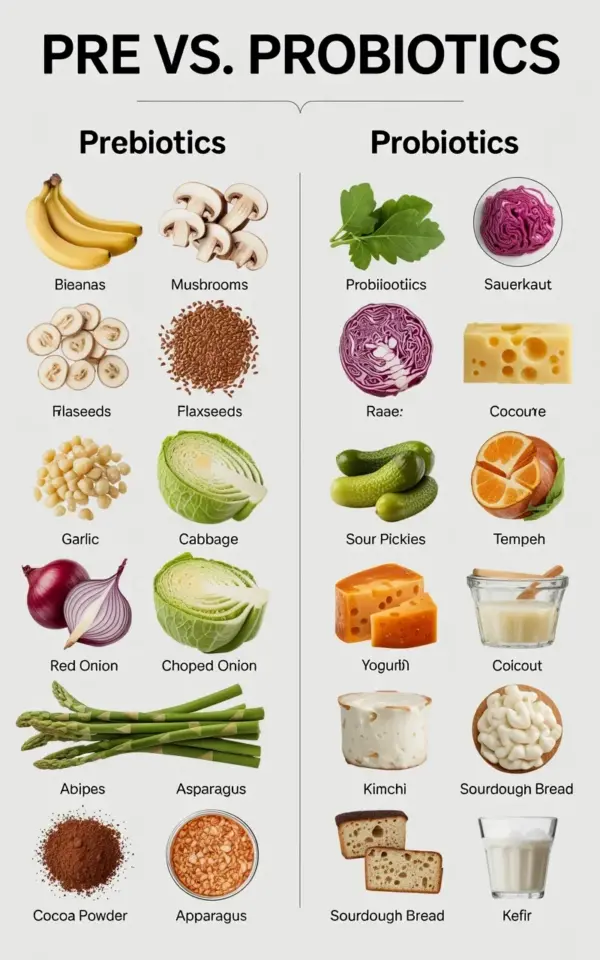
Look, a lot of the advice floating around about gut health reads like it was written for a science journal, not a real kitchen. Anyone can say “eat more prebiotics,” but what does that actually look like on your plate at 6 PM on a Tuesday? That colorful infographic you saved to your Pinterest board, the one with the two columns of everyday foods, it’s a better starting point than most. The title says “Pre vs. Probiotics,” and it gets straight to the point, showing bananas, garlic, and cocoa powder on one side, sauerkraut, raw cheese, and sour pickles on the other. But there’s a big difference between looking at a chart and knowing how to use it without making a mess of your meals and your digestion.
The Most Common Mistake? Thinking Probiotics and Prebiotics Are the Same Job
This is the big one, the confusion that makes people buy expensive supplements that do absolutely nothing for them. Probiotics are the live bacteria themselves, the tiny microorganisms that help your gut do its thing. Prebiotics, on the other hand, are the food that keeps those little guys alive and working. It’s a totally different role. You can swallow all the probiotic capsules in the world, but if you aren’t also giving those bacteria something to munch on, they won’t stick around for long.
Think of it like having a pet. The probiotic is the fish, the prebiotic is the fish food. Buy a fish and no food? You end up with a sad, empty bowl. Buy the food but no fish? Well, you just have a jar of flakes. You need both. The infographic gets this right by putting them in separate columns, but the mistake comes when people pick just one and call it a day. Don’t be that person with the expensive fish and no food.
Prebiotics Are Not the Villain (And They’re Not Probiotics’ Sidekick)
Ok so, prebiotics often get treated like the boring sidekick in the gut health movie, but they deserve a lot more respect. They are, very simply, types of fiber and natural compounds that your body can’t digest, but your gut bacteria absolutely love. Some are more like galacto-oligosaccharides (try saying that five times fast) found in certain beans and dairy, while others are inulin, which is plentiful in bananas and garlic. That sliced banana and diced garlic in the photo? That’s your bacteria’s favorite dinner.
But here’s the thing. Prebiotics aren’t just about making bacteria happy. They contribute to regular bowel movements, better mineral absorption, and they help maintain a robust gut lining. Honestly, they do the heavy lifting, so it’s a shame they don’t get the spotlight more often.
And before you ask, no, you can’t just eat a giant bowl of raw garlic and call it a day. That’s a good way to upset your stomach and alienate everyone in a three-meter radius. You need them consistently, which is why learning to build them into normal cooking matters more than chugging a supplement.
Probiotic Foods Are Not All Created Equal, Especially Raw Cheese
Now for the other column. Probiotic foods are the ones that contain live cultures, the actual good bacteria. Your infographic shows sauerkraut, raw cheese, and a sour pickle, which are all classic examples. But you need to understand the catch: not every version of these foods has live cultures. A lot of commercial sauerkraut is pasteurized, which kills all the beneficial bacteria before it ever reaches your mouth. It’s just cabbage that tastes sour, not a functional food.
Here’s a practical tip: look for “raw,” “unpasteurized,” or “live cultures” on the label. Real sauerkraut is often in the refrigerated section of the store, not sitting on a shelf at room temperature. That little detail matters so much.
And about that raw cheese. It’s a great source of probiotics, sure, but there’s a reason we don’t eat cheese by the block. Moderation is the whole game. Look for things like aged cheddar, gouda, or mozzarella that are made from raw milk if you can find them. But honestly, eating pasteurized yogurt with active cultures is going to be way more practical for most people on a busy weekday. The pickle in the photo is a great example, but only if it’s a naturally fermented pickle in a brine, not one made with vinegar. Vinegar pickles are tasty, for sure, but they don’t have the bacteria you want.
How to Actually Combine Them for Better Gut Health
Ok so, now that we know the difference, the real magic happens when you combine them and let them work together.
You don’t need a complicated chart or a meal plan that looks like a Pinterest crafter threw up on it. You just need to build meals intentionally. Here are a few easy ways to actually do it, borrowing from that infographic you’re saving:
- Slice a banana over a bowl of plain yogurt for breakfast. Both are in the photo, and they’re a perfect duo. The yogurt delivers the live bacteria, and the banana hands it the fuel.
- Add some raw, fermented sauerkraut to a sandwich or a grain bowl. A little tang goes a long way.
- Use minced garlic and chopped onion as a base for almost every savory dinner. You’re not just adding flavor, you are adding prebiotic fiber to your entire plate.
- Grate some raw cheese over your roasted asparagus, because eating plain steamed asparagus is a sad affair anyway, and it pairs a probiotic with a prebiotic.
See how that works? You aren’t overhauling your life; you’re just tweaking what you’re already making. The mistake most people make is treating these as “health foods” you have to force yourself to eat, rather than just… food. It’s about building a meal that helps your gut without thinking too hard about it.
Gut Health Foods Are Only Part of the Equation, Here’s the Weird Part
You can eat all the right stuff, but if you’re chewing while stressed out or eating on the run, you’re undoing a lot of the benefit. Your gut and your brain are deeply connected, a two-way street of signals. If your nervous system is screaming “danger” or “deadline,” your body is not prioritizing digestion, no matter how many probiotic-rich foods you inhale.
I once went through a spell where I ate the perfect gut-health diet for two weeks straight and felt terrible. I was eating sauerkraut, raw cheese, drinking kefir, eating all the right things, and yet my stomach was still in knots. Turns out, I was rushing every single meal and working through lunch, which meant my body was essentially working against all that good food. As soon as I slowed down, even just for five minutes, my digestion sorted itself out. It’s not all about the plate.
A Simple Plan to Fix Your Gut Food Routine (Without Overthinking It)
So, we’ve covered the common mistakes. Let’s simplify how to move forward without turning your kitchen into a biochemistry lab.
First, don’t panic about probiotics and prebiotics being too complicated to manage. They’re just food. Start with the items in that infographic that you actually like to eat. If you hate bananas, guess what? You don’t have to eat them. There are plenty of others to choose from.
Instead, try to focus on this. Always pair a live culture with a fiber source. It doesn’t have to be fancy. Eat a bowl of oatmeal with flaxseeds and top it with a spoonful of yogurt. Or, have a serving of cocoa powder in your morning smoothie with some raw cheese on toast? Wait, that’s a terrible combo. Don’t do that. But you get the point, it’s about building a team.
And if you do want to branch out, try some roasted cabbage wedges with a creamy probiotic dressing, or some sautéed mushrooms and onions with a dollop of yogurt sauce. These are all items from the image, just moved around and made into real dishes. It should feel easy.
The Bottom Line for a Happier Gut
This doesn’t have to be a major project. You don’t need a cabinet full of capsules, just a better chance of getting the right foods in. It takes a little trial and error to know how your own body reacts, but then it becomes second nature. Just keep that handy guide in mind and start with one meal. Pick one new gut-friendly swap from the infographic and try it out tonight.
Save that visual guide to your board and use it on your next grocery run. Your gut will let you know if you’re doing it right, trust me.
Leave a Comment